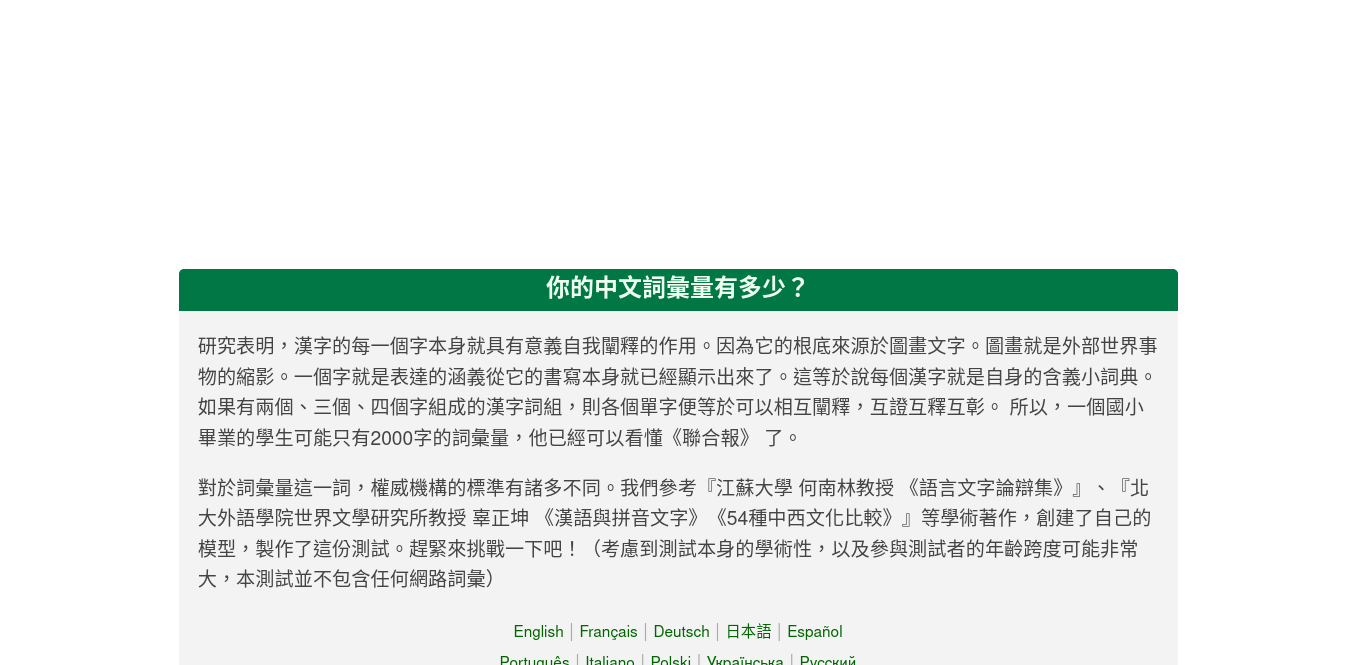
Some studies claim that every Chinese character has the function of explaining its own meaning, as their origins date back to pictographic writing. These drawings are essentially miniatures of objects from the outside world, and a character expresses its various meanings through its written form. This means that each Chinese character is its own little dictionary. In a phrase made up of two, three, or four characters, each can be interpreted in relation to the others, mutually corroborating, explaining, and clarifying one another. Thus, a Chinese student who has completed primary school may only know about 2,000 characters, but will already be capable of reading and understanding a Chinese newspaper.
There are many discrepancies among the standards followed by authoritative institutions regarding the number of characters required for fluency in Chinese. Therefore, to establish our own model and develop this multiple-choice exam, we have consulted various academic works, such as "Essays on Language and Writing" by He Nanlin, a professor at Jiangsu University; and "Chinese and Phonetic Writing" and "54 Comparative Aspects Between Chinese and Western Culture" by Gu Zhengkun, a professor of World Literature at the Faculty of Foreign Languages of Peking University.
Come and take the challenge!
(Given the academic nature of the exam and the potential wide age range of participants, no internet slang has been included).
Users’ rating
5
0%
4
0%
3
0%
2
0%
1
0%
0
0%
0 Votes
Experts rating
2/5
Language level
Beginner
Intermediate
Advanced
CEFR level
-
HSK level
-
HSKK level
-
YCT level
-
Skill
Vocabulary
Kind of access
Open
Registration required
None
Type
Tool
Poetry
Keywords
-
Format
Web
Linguistic variant
Cantonese
Classical Chinese
Standard Chinese
Traditional characters
Vehicular language
Standard Chinese
Traditional characters
Young learners
No
For teachers
No
Remarks
The scope of the website is very narrow. It measures your amount of vocabulary.
Rating
Rate this resource
Report
Use this form to report an issue with the resource or to make a comment about it.
Subscribe if you want to receive a weekly email with direct links to new resources. This message will only be sent if there are new entries in our database. If you wish to unsubscribe, you can do so at any time by using the designated link in the emails we send you.
Cookies disclaimer
I agree
Our site saves small pieces of text information (cookies) on your device in order to deliver better content and for statistical purposes. You can disable the usage of cookies by changing the settings of your browser. By browsing our website without changing the browser settings you grant us permission to store that information on your device.